 Book an Appointment Lal Darwaza branch
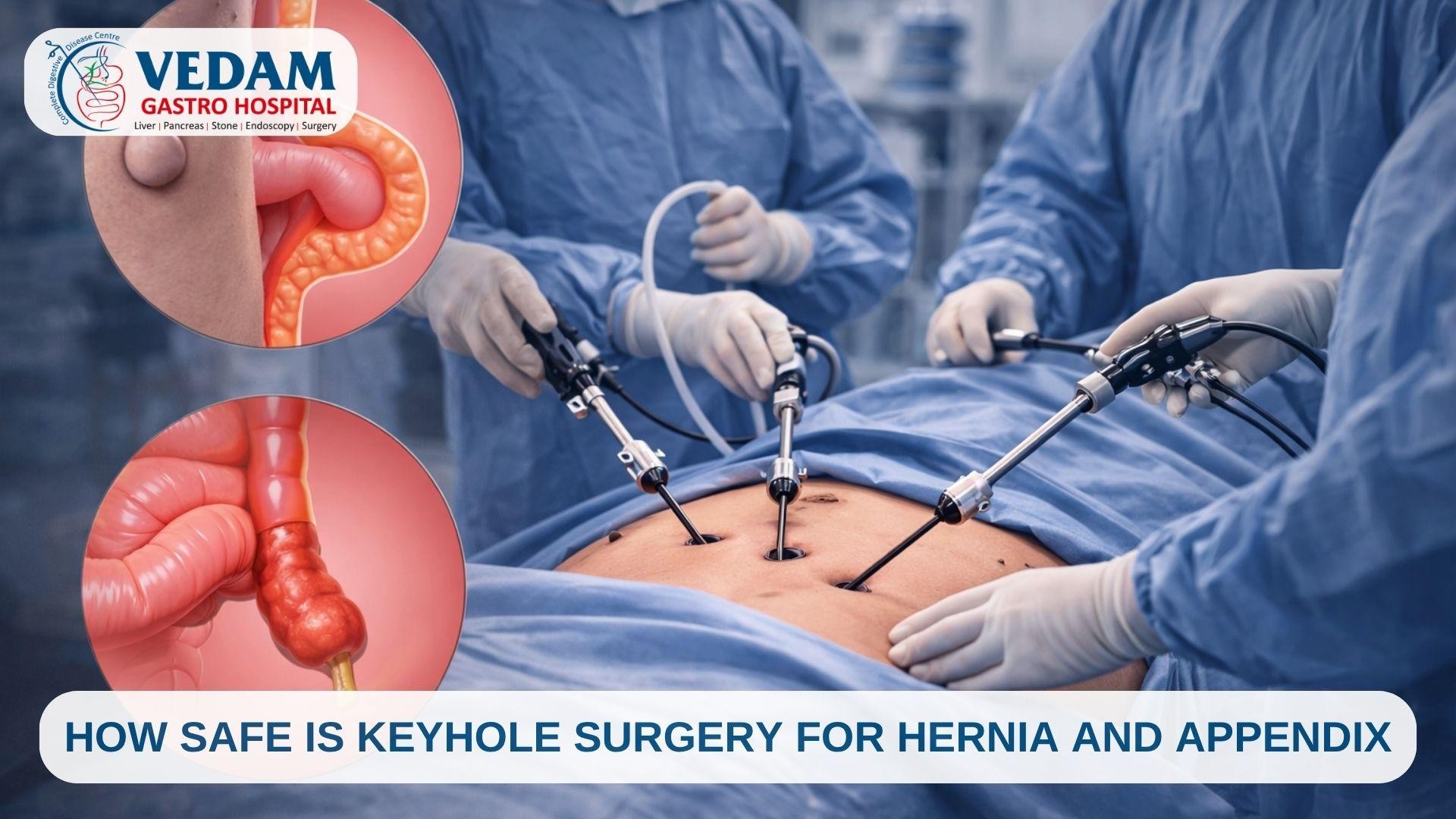
Just a hint of surgery for a hernia or appendicitis, and your mind probably jumps straight to one question. Is this safe? To top it off, the doctor mentions keyhole surgery and your thoughts spiral once again. Hernias are one of the most common reasons keyhole surgery is used. In experienced hands, it’s considered very safe. In fact, for many patients, it’s safer than open surgery.
Let’s understand this from our experts at Vedam Gastro Hospital, one of the best gastrosurgeon in Surat.
What Is Keyhole Surgery ?
Keyhole surgery is a technique where surgeons operate through a few small openings instead of one large cut. A tiny camera goes in through one opening, and fine instruments go in through the others. The surgeon watches everything on a screen while working inside your body.
If that sounds a little unsettling, you’re not alone. Watching a screen while operating sounds less reassuring than “open it up and look directly.” But here’s the thing. Surgeons see more detail this way, not less. The camera magnifies everything. Blood vessels, nerves, inflamed tissue. Nothing is hidden.
That visual clarity plays a big role in safety, say the experts from Vedam Gastro Hospital, considered as one of the best gastro hospitals in Surat.
How Safe Is Hernia Surgery With Keyhole Surgery?
Smaller incisions mean less trauma to muscles and tissues. Less trauma usually means less pain after surgery, lower risk of infection, and faster movement afterward. Getting up and walking sooner is not just about comfort. It helps prevent clots and stiffness.
There are risks, of course. No surgery is risk free. With hernia repair, potential issues include bleeding, infection, or recurrence of the hernia later. These risks exist with open surgery too. Studies and real world outcomes show that when done by trained surgeons, keyhole repair does not increase these risks and often lowers them.
One thing the best stomach hospitals in Surat do take seriously is patient selection. Someone with multiple previous abdominal surgeries or severe scarring may not be the best candidate. Safety improves when the right technique is used for the right person.
Safety in Appendix Surgery
Appendix surgery is often done in a hurry. Appendicitis does not wait politely. That urgency makes people nervous, and understandably so.
Keyhole surgery for appendix removal has been used for decades now. It is widely considered safe, even in emergency situations. Surgeons can quickly locate the appendix, assess infection, and remove it with minimal disruption to surrounding organs.
Patients often notice the difference afterward. Less soreness when coughing. Less pulling sensation when standing up. Smaller scars that fade faster. More importantly, there is usually a lower chance of wound infection compared to open surgery, especially when the appendix has ruptured.
In complicated cases, such as widespread infection, surgeons may still switch to open surgery mid procedure. That is not a failure. It is a safety decision. The priority is always control and visibility.
Anesthesia and Recovery Concerns
Many people worry that keyhole surgery somehow involves “more” anesthesia. It does not. The anesthesia used is similar to open procedures.
What often feels different is recovery. Patients are usually surprised by how quickly they feel human again. Sitting up feels easier. Breathing deeply does not hurt as much. That matters, because shallow breathing after surgery can lead to lung problems.
Most people go home sooner after keyhole surgery. Some hernia patients return the same day. Appendix patients often leave within a day or two. Faster discharge does not mean corners are cut. It means the body has less healing to do.
Surgeon Experience Matters More Than the Technique
Here’s an honest opinion that deserves space. The safety of keyhole surgery depends less on the method and more on who is holding the instruments.
A well-trained surgeon who performs these procedures regularly will deliver safer outcomes than someone who rarely does them, like the best stomach specialists in Surat at Vedam Gastro Hospital. That’s why asking questions is necessary. How often do you perform this surgery? What complications do you watch for? What happens if something unexpected shows up?
So, How Safe Is It Really?
For most people, keyhole surgery for hernia and appendix problems is very safe. It has a long track record, strong outcomes, and clear benefits when used appropriately. Smaller cuts do not mean bigger risks. Often, they mean smarter surgery.
If you’re facing this decision, trust the evidence, trust experience, and trust your instincts. A calm explanation from your surgeon usually tells you more than any online search ever will.
FAQ
1. How safe is keyhole surgery for appendicitis and hernia?
Most people think that keyhole surgery is safe and common for both repairing hernias and removing appendixes when done by a skilled surgeon. It often makes smaller cuts, hurts less, has a lower risk of wound complications, and lets you heal faster than open surgery.
2. Is laparoscopic surgery better than open surgery for an appendix or hernia?
People often choose laparoscopic surgery to treat hernias and appendicitis because it usually requires smaller cuts, causes less pain after surgery, and allows them to get back to their normal activities faster. The best choice, though, depends on the patient’s health, the kind of hernia, the severity of appendicitis, and what the surgeon thinks.
3. What are the dangers of keyhole surgery for hernias and appendices?
Keyhole surgery, like any other surgery, has some risks, such as bleeding, infection, damage to nearby organs, problems with anaesthesia, or the need to switch to open surgery for safety reasons. Still, it is widely used because it is thought to be safe and effective for the right patients.
4. How long does it take to heal after keyhole surgery for an appendix or hernia?
Most of the time, recovery after keyhole surgery is faster than after open surgery. Many patients can walk the same day or the next day, go back to light activity in a few days, and fully recover in the next couple of weeks. This depends on whether the surgery was for hernia repair or appendicitis and whether there were any problems.
5. Who is a good person to have keyhole surgery on their hernia and appendix?
A good candidate for keyhole surgery is usually someone whose hernia or appendix problem can be safely fixed with a method that doesn’t require a lot of cutting. The size and type of hernia, the severity of the infection, any past abdominal surgeries, the person’s age, and their overall health are all things that help decide if laparoscopic surgery is the best option.
6. Is it possible to do keyhole surgery in cases of appendicitis or hernia that need it right away?
Yes, keyhole surgery can often be used in emergencies like acute appendicitis or some hernias that cause symptoms, as long as the patient is stable and the surgeon thinks it’s the safest way to go. In some cases that are more complicated or serious, open surgery may still be needed.
7. Do smaller scars come from keyhole surgery?
Yes, keyhole surgery usually leaves smaller scars because it uses a few small cuts instead of one big one. This is one reason why a lot of people choose it for appendix and hernia surgery.