 Book an Appointment Lal Darwaza branch
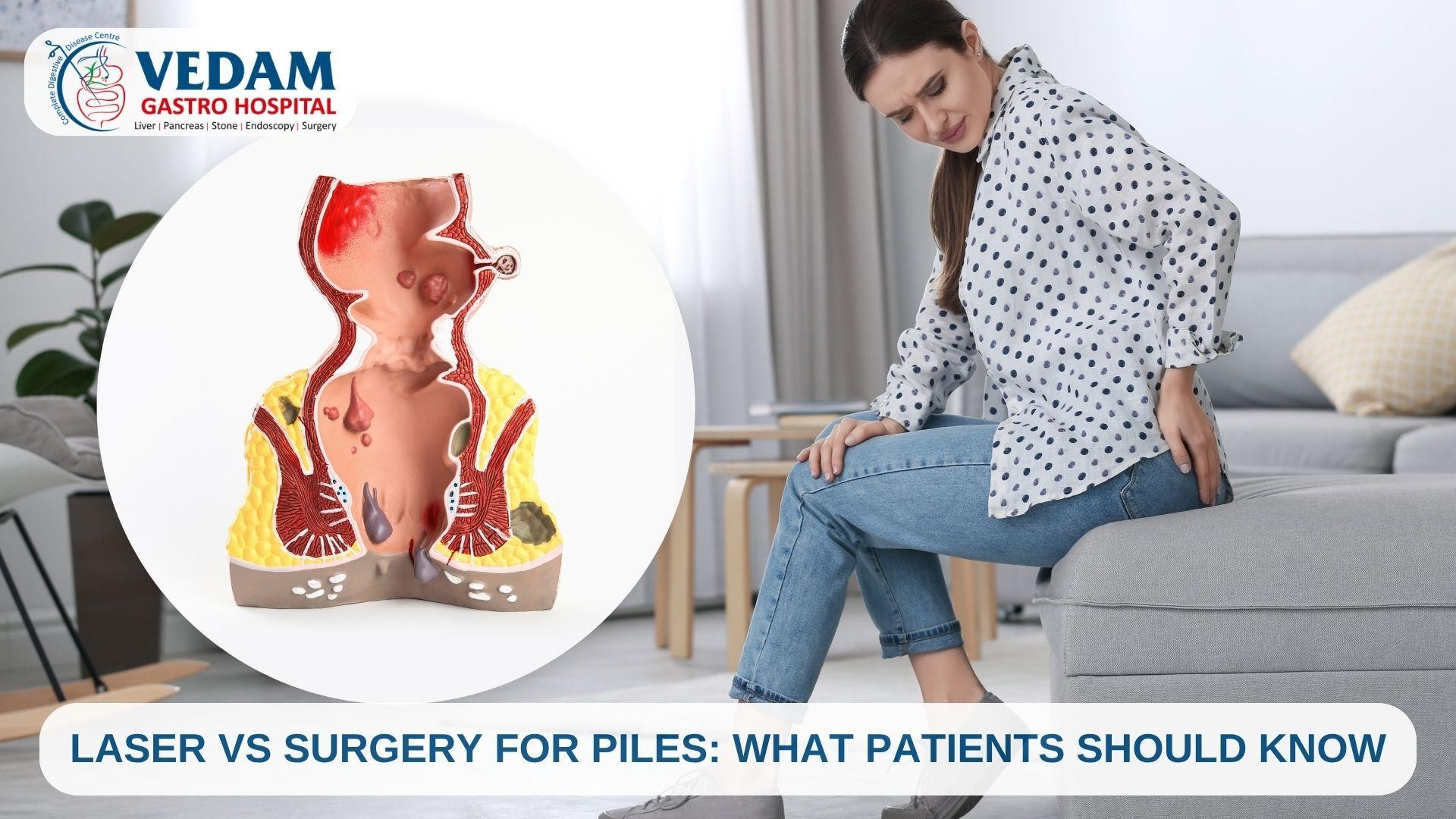
When deciding between laser and surgery for piles, you should think about how big the piles are, how often they bleed or come out, how much they bother you in your daily life, and whether simpler treatments have already failed. Laser may be a good option for some patients with mild to moderate cases. Surgery may provide a more comprehensive and enduring solution in advanced or recurrent cases. Our Gastros surgeon in Surat at Vedam Gastro Hospital, should look at you to help you decide what to do. This is because the best treatment for piles depends on how far along the disease is, not just what seems easier.
What are piles, and when do they become a problem?
Haemorrhoids, or piles, are veins that have become swollen in or around the anus and rectum. Chronic constipation, straining during bowel movements, sitting for too long, a low-fiber diet, pregnancy, or repeated pressure in the lower rectal area can all cause them to happen.
At first, piles may only make you itch, feel a little uncomfortable, or see a little blood when you go to the toilet. But as time goes on, the symptoms may get worse. Some people get swelling, pain, mucus, or a lump that comes out when they poop. Some people stop using the toilet because they are afraid of pain or bleeding. That’s usually when piles stop being a small problem and start to make life worse.
Is laser treatment better than surgery for piles?
This is the first question that most patients ask, but there is no one answer that works for everyone. Laser treatment isn’t always better, and surgery isn’t always harder. They all have their own place, says our specialists being one of the best colorectal surgeon in Surat.
People usually choose laser treatment for piles when there is a less invasive way to treat the pile mass. It is often linked to less cutting, smaller wounds, and a faster return to normal activities. That’s why a lot of people want to go there.
When piles are big, prolapsed, come back, or are linked to a lot of swelling on the outside, surgery is usually the best option. In these cases, surgery may be able to remove more of the diseased tissue and give you better long-term control.
So the better question isn’t whether to use lasers or surgery in general. The better question is: which one is best for the severity and grade of your piles?
When is laser treatment appropriate for piles?
When laser might work:
The piles aren’t too big, the symptoms are annoying but still in a treatable stage, and the disease isn’t too widespread.
The patient wants a way that is as little invasive as possible.
The surgeon thinks that lasers will work well for that body type.
It’s easy to see why laser treatment sounds good. Patients often think they will have less pain, stay in the hospital for less time, and get better faster. In a lot of cases where it’s appropriate, that expectation can be fair.
But lasers aren’t a quick fix for all kinds of piles. Lasers may not always be the best option if the disease is advanced, comes back, or affects more structures.
When is it better to have surgery for piles?
When surgery is needed, it is often recommended.
There are large piles that keep coming out, bleeding regularly, painful or thrombosed swelling, or a mix of internal and external piles.
Symptoms keep coming back even after taking medicine or having surgery. Daily life is being greatly affected.
In these cases, surgery might be the best option. Patients sometimes put off surgery because it sounds more serious, but in some cases, it may be the treatment that gives the most long-term relief.
A colorectal surgeon in Surat will usually make this choice after looking at the grade of the piles, how far they have prolapsed, the external part, and the patient’s history of symptoms.
How does a doctor choose between laser and surgery?
Most of the time, the choice is based on a few practical things:
how far along the piles are, if they stay inside or come out, how often bleeding happens, if there is pain, swelling, or clotting, if the patient has already tried non-surgical treatment, and if there are other problems like a fissure or fistula.
This is why diagnosing yourself can be wrong. Two patients may both say they have piles, but the stage and treatment may be very different. One option that is not very invasive may help. Another person may need a more serious operation.
What is the recovery time like after laser or piles surgery?
How long it takes to get better depends on the treatment and how bad the condition is. In general, laser treatment is often linked to a quicker return to normal activities when it’s appropriate. If the piles are big or complicated, surgery may take a little longer to heal.
Aftercare is very important in both cases. Patients usually have an easier time recovering when:
Get enough water
eat a lot of fibre
Keep your stools soft, don’t strain, take your medicines as directed, and keep your bowel habits good.
A lot of patients make the mistake of only thinking about the procedure and not the habits that led to the piles in the first place. Even the best treatment works better when you really care about getting better and staying healthy.
What questions should patients ask before they choose a treatment?
Before you make a decision, make sure to ask these questions:
What kind of piles do I have?
Is laser a good option for me?
Will surgery work better for me in the long run?
What kind of recovery should I look forward to?
What are the odds of it happening again?
What changes do I need to make to my life after treatment?
These questions help patients make smart choices instead of just picking based on fear, price, or marketing language.
Final thought
Both laser and surgery can help treat piles. In some cases, laser treatment can be a good choice. If your piles are bigger, more advanced, or keep coming back, surgery may be the best option. The best way to stay safe is to not chase after the newest treatment, but to pick the one that works best for your disease.
If you have bleeding, swelling, pain, or piles that keep coming back, it is a good idea to see the best colorectal surgeon in Surat. Getting the right diagnosis often makes it easier to choose the right treatment, and getting treatment early can stop a problem from getting much worse later.
FAQ
1. Will laser treatment for piles last forever?
Laser treatment can work in some cases, but it doesn’t always work in the long term. It depends on the grade of the piles, the method used, and whether the patient changes their bowel habits afterward.
2. Are all piles good candidates for laser treatment?
No. Some piles are too big, too advanced, or too complicated for lasers to be the best choice.
3. Is surgery for piles more painful than laser surgery?
The time it takes to heal can be different for each patient. Laser is often associated with less immediate discomfort in selected cases, but surgery may offer better results in advanced disease.
4. After treatment, can piles come back?
If you keep having constipation, straining, and bad bowel habits, piles can come back even after treatment.
5. When should I go to a doctor for piles?
If you keep bleeding, swelling, feeling pain, or having prolapse, or if your symptoms don’t get better with simple treatment, you should see a specialist.